
Landscaping
How Landscaping Companies Manage Seasonal Cash Flow
A Practical 7-Step Guide for Landscaping Business Owners for managing seasonal cash flow
4 min read
On this page
- A Practical 7-Step Guide for Landscaping Business Owners
- How the Seasonal Cash Flow Cycle Works
- Step 1: Track Job Profitability
- Step 2: Build a 12-Month Cash Flow Forecast
- Step 3: Maintain an Operating Reserve
- Step 4: Improve How Quickly Cash Comes In
- Step 5: Monitor Labor and Crew Productivity
- Step 6: Plan Equipment Purchases Carefully
- Step 7: Extend Revenue Beyond Peak Season
- Quick Seasonal Cash Flow Checklist
- What a Healthy $1M Landscaping Company Looks Like
- Here's a Quick Example From One Landscaping Company
- When Landscaping Companies Consider Outsourced Financial Help
- Building Financial Stability in a Seasonal Industry
A Practical 7-Step Guide for Landscaping Business Owners
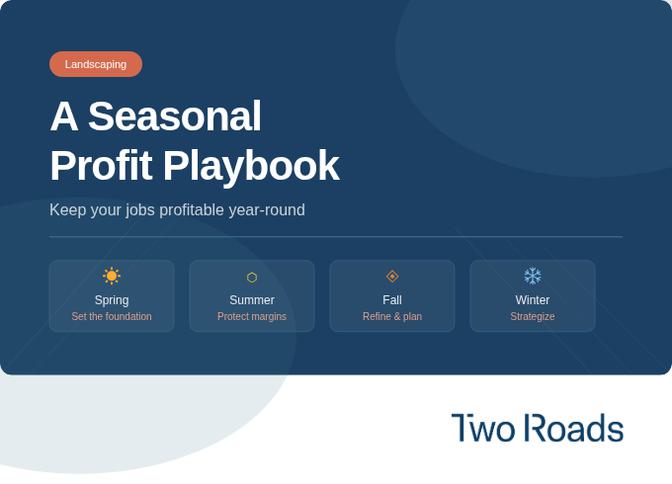
If you run a landscaping company, you already know the rhythm of the year. Spring arrives and everything ramps up quickly. Crews are hired. Equipment gets repaired or replaced. Schedules fill with maintenance visits, installs, and new projects. Revenue starts coming in. But many of the largest expenses happen before that revenue fully ramps up.
- Payroll increases
- Trucks need maintenance
- Materials have to be ordered
- Insurance and equipment payments continue regardless of demand
This creates financial pressure and not because the business is failing, but because cash flow works differently in seasonal industries.
82% of small business failures are related to cash flow issues, not lack of revenue. Source: U.S. Bank Small Business Survey
The landscaping companies that manage seasonality well don’t eliminate the cycle, they build systems that help them plan for it.
How the Seasonal Cash Flow Cycle Works
Most landscaping companies follow a predictable financial pattern:
Peak months must generate enough revenue to support the entire seasonal cycle.
The busy season isn’t just about covering expenses — it prepares the business for slower months ahead.
Step 1: Track Job Profitability
Many landscaping companies track revenue but don’t track profitability by job.
Without job costing, it becomes difficult to answer:
- Which services are most profitable?
- Are projects underpriced?
- Are labor hours exceeding estimates?
- Which crews are most efficient?
Simple Job Margin Formula
Revenue – Direct Job Costs = Gross Profit
Example
Job Revenue $5,000 - Labor $2,000 - Materials $1,000 - Equipment Allocation $500
= Gross Profit $1,500
= Gross Margin 30%
Typical Industry Margins
Lawn maintenance 35–45%
Landscape installations 30–40%
Hardscaping 25–35%
Step 2: Build a 12-Month Cash Flow Forecast
A forecast helps answer:
- When will revenue spike?
- When will expenses increase?
- Which months require reserves?
Include:
- Payroll and labor
- Equipment payments
- Insurance
- Materials
- Rent and software
- Taxes and owner pay
Step 3: Maintain an Operating Reserve
Seasonal businesses should maintain 3–6 months of operating expenses.
Monthly Expenses
Payroll $18,000
Insurance $2,500
Equipment $4,000
Office & Software $1,500
Utilities $1,000
Total $27,000
Reserve Target: $108,000 (4 months)
Step 4: Improve How Quickly Cash Comes In
Cash flow problems are often timing problems.
- Require deposits
- Use progress billing
- Invoice immediately
- Offer ACH/card payments
- Track receivables weekly
Step 5: Monitor Labor and Crew Productivity
Key Benchmarks
Metric Benchmark Labor Cost % 35–50%
Revenue per Employee $135,000
Revenue Per Crew Per Day
Daily Revenue Target
2-person: $1,200–$1,800
3-person: $2,000–$3,000
Step 6: Plan Equipment Purchases Carefully
- Commercial mowers
- Trucks
- Trailers
- Skid steers
- Irrigation tools
Typical investment: $70,000–$200,000
[INSERT IMAGE: Equipment / Fleet Image]
Step 7: Extend Revenue Beyond Peak Season
- Fall cleanups
- Irrigation winterization
- Hardscape installs
- Snow removal
- Holiday lighting
Quick Seasonal Cash Flow Checklist
- ✔ Track job profitability
- ✔ Build a 12-month forecast
- ✔ Maintain reserves
- ✔ Improve invoicing speed
- ✔ Monitor labor productivity
- ✔ Review expenses
- ✔ Expand off-season services
- ✔ Secure credit early
- ✔ Review financials monthly
What a Healthy $1M Landscaping Company Looks Like
Many owners ask how their business compares to industry benchmarks. Here is a simplified example of a healthy $1M landscaping company financial structure according to NALP Industry Benchmark Study and the Landscape Management Magazine Industry Report
Category | Typical % | Example Revenue = $1,000,000
Labor | 40–45% | $420,000
Materials | 15–20% | $170,000
Equipment | 8–10% | $90,000
Overhead | 15–20% | $180,000
Net Profit | 10–15% | $120,000
Small improvements in pricing, labor efficiency, or job margins can significantly impact profitability.
Here's a Quick Example From One Landscaping Company
A premier landscaping company, The Govert Group came to Two Roads at ~$528K in revenue but lacked clear financial visibility. Reporting was inconsistent, and key decisions were being made without reliable data. After implementing structured reporting and improving invoicing and payroll systems, revenue grew from $527K to $1.2M in 18 months, a 128% increase!
More importantly, the owner gained clear visibility into margins and cash flow, enabling them to confidently acquire another business and expand their services.
When Landscaping Companies Consider Outsourced Financial Help
As landscaping companies grow, financial management becomes more complex. DIY-ing is no longer an option. Common signals it may be time to bring in outside financial support include:
- Financial reports are inconsistent
- Job profitability is difficult to track
- Cash flow planning feels reactive
- Hiring or equipment decisions are difficult to evaluate
- The business is growing but financial visibility is limited
Outsourced financial services for landscaping and professional services can help provide reporting, forecasting, and strategic guidance while allowing owners to focus on running the business.
Building Financial Stability in a Seasonal Industry
Seasonality will always exist. Financial stress doesn’t have to. With the right systems in place, landscaping companies can operate with greater clarity and confidence throughout the year.
👉 Speak with a Financial Expert Today and Plan For Tomorrow.
Sources & Industry Benchmarks


Choose to invest in yourself.
Have a question these articles don't answer for your business? Schedule a call and we'll get to know you, your business, and what you're looking for.
Schedule a Call